
What just changed
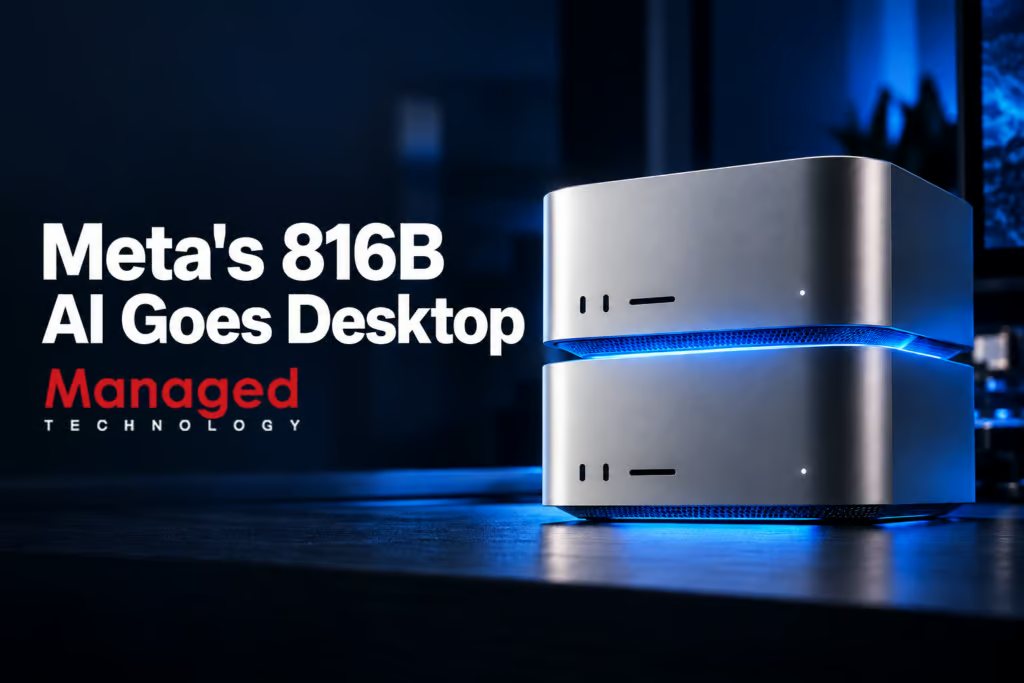
Developers can now download an 816-billion-parameter open-weight model and run it on a pair of Apple Mac Studios on the desk. Meta released the weights for Muse Spark Open on October 15, 2026, alongside hosted API access through seven inference partners.
What Muse Spark Open is
Muse Spark Open is a natively multimodal model with 816 billion total parameters and 42 billion active per token, using a mixture-of-experts design. The 1-million-token context window supports long-running agentic work, multi-step reasoning, and complex software engineering tasks. Meta describes it in its release as “the most capable US open-weight model to date” and positions it for coding and agentic workflows where the model plans and acts across many steps rather than answering a single question.
The release is an open-weight one, which means the trained weights are published for download. The source release notes that “the freedom to run advanced models wherever, including at home” is part of the point.
Why two Mac Studios matter for a small IT team
Muse Spark Open is “the first model in its class to run on your desktop using two Apple M5 Ultra Mac Studios with the latest MLX framework,” according to Meta’s release. Apple’s unified memory architecture lets the integrated GPU on each M5 Ultra address up to 512 GB, so two machines together can hold the full model. Each M5 Ultra chip provides 1.2 TB/s of memory bandwidth, which is enough to read the small slice of weights each token needs.
Meta’s developer documentation adds a second configuration: MLX can serve the NVFP4 checkpoint from “either two Mac Studios, with M5 Ultra and 512GB of unified memory; or four Mac Studios with 256GB of unified memory, for a total of 1TB of unified memory, enough to hold a NVFP4 quantized version of Muse Spark Open.” The two- or four-machine setup is tied together with Thunderbolt 5 and RDMA, with MLX tensor parallelism splitting every layer across the machines so weights never move and only small intermediate results travel between them.
What the model did in Meta’s own tests
Meta tested on-device agentic workflows using Muse Code, the coding product built on Muse Spark Open. Two examples from the release:
- Shipping real iOS changes to Ice Cubes, an open-source Mastodon client, including bug fixes, new features, and full builds.
- Driving DaVinci Resolve end to end, with the model reviewing footage frame by frame to find the strongest moments and crop them vertically.
These are end-to-end tasks where the model is acting on real software and real media, not answering trivia.
Where to get the weights and the API
Model weights are available for download on Amazon SageMaker AI, Google Cloud Model Garden, Hugging Face, and Microsoft Foundry Models. Hosted inference is offered through Baseten, Fireworks AI, Groq, Modal, Nebius, OpenRouter, and Together AI. The Hugging Face collection at huggingface.co/collections/meta-models/muse-spark-open is the starting point for downloads.
On the engine side, the open-weight release ships with custom, auto-tunable Helion GPU kernels in SGLang, delivering 1.03x to 3.95x kernel-level speedups on NVIDIA and AMD GPUs, plus a 3% end-to-end speedup on AMD MI350. The model runs on SGLang, vLLM, TensorRT-LLM, Hugging Face Transformers, Apple MLX, llama.cpp, and Unsloth, with optimizations for AMD, Apple, Intel, and NVIDIA silicon. Developers can further customize the model using PyTorch’s TorchTitan, and on Apple silicon, MLX pulls the weights directly from Hugging Face.
Safety and license
The release includes additional safety post-training suited to open-weight deployment, with evaluations covering the most severe risk categories. The model was evaluated under Meta’s Superintelligence Scaling Framework and met the thresholds required for release. Detailed results are in the model card, with a full evaluation report to follow.
The weights are released under the Muse Model License with limited commercial terms, which allow many developers to use the model for free. As with any open-weight model, the buyer of two Mac Studios and the integrator setting it up should read the license for the specific commercial use case.
What to do now
1. Decide whether local inference fits the use case.
2. Size the hardware before buying.
3. Pick the right deployment path. For Apple silicon, use MLX, which pulls weights directly from Hugging Face.
4. Put a usage policy in writing before the model sees real data.
5. Plan a pilot. Start with a non-production task, like generating tests, summarizing tickets, or scripting report jobs, and measure latency, accuracy, and what the model got wrong.
FAQ
What is Muse Spark Open?
Muse Spark Open is an 816B-parameter natively multimodal open-weight model with 42B active parameters and a 1M-token context window, built for coding and agentic work.
Can Muse Spark Open run on a desktop?
Yes. Meta’s developer documentation says MLX can serve the NVFP4 checkpoint from either two M5 Ultra Mac Studios with 512GB each or four 256GB Mac Studios totaling 1TB of unified memory, connected with Thunderbolt 5 and RDMA.
Where can developers download or access Muse Spark Open?
Weights are available on Amazon SageMaker AI, Google Cloud Model Garden, Hugging Face, and Microsoft Foundry Models. Hosted inference is available through Baseten, Fireworks AI, Groq, Modal, Nebius, OpenRouter, and Together AI.
BizScoreAI

BizScoreAI scores how visible a business is to AI search and shows what its listing looks like to the engines people ask. Open the free listing check.